Prairie Portraits
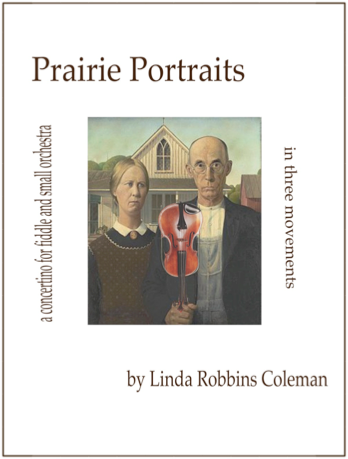
Prairie Portraits
a concertino
for violin (fiddle) and small orchestra
in three movements
Movement Duration
1. Pleasant Mount Pleasant 4:30
2. Waverly Waltz 4:00
3. Yee-Haw Hoedown in What Cheer!4:30
Enjoy it on YouTube:
https://www.youtube.com/watch?v=cdMvISZ6YcY
Program Notes - New in 2021
Prairie Portraits is a fun and spirited, three movement concertino for violin (fiddle) and small orchestra. It was commissioned and premiered by the Wartburg Symphony as part of the Iowa Sesquicentennial Celebration. Music director Janice Wade said that she thought it might be fun to have a piece that would reflect a historical aspect of our history and asked me to write something that would sound like old Iowa dances featuring a folk instrument played by an Iowan. Each of the three movements are named after a small town in Iowa: “Pleasant Mount Pleasant,” “The Waverly Waltz,” and “Yee Haw Hoedown in What Cheer!”
The original version was written for another instrument and premiered with noted University of Iowa Emeritus Professor of Musicology, Frederick Crane, performing on the trump (a.k.a. mouth harp, jaw harp, or juice harp). Amazingly enough, it was wonderfully received and ended up having many performances throughout Iowa with Professor Crane appearing onstage in bib overalls!
Of course from the beginning we all knew that the pool of classical music mouth harp soloists is very small, so it was always my intention to create another edition to provide more performance opportunities. In 1998, Prairie Portraits, now for violin/fiddle and small orchestra, was born. I might note that the term “fiddle” is use more to convey a “classical meets country” flavor of the music rather than requiring specific fiddle techniques to perform it. It doesn’t have long improvised sections like one would find in true fiddle music, and the interplay between the orchestra and the soloist is what you would find in most classical concertinos. The new fiddle version enjoyed a few performances until 2000 when I had to withdraw from the concert world to become a caregiver for a few years. The music got put in a drawer and forgotten.
A couple of years ago another conductor asked me to make Prairie Portraits available again. I thought that was a marvelous idea, especially as Iowa celebrates its Demisemiseptcentennial (aka quartoseptcentennial) in 2021. I worked with a professional violinist to make sure the solo part would be at its best, I made a new engraving of the score and parts, and voila!
Conductor Notes
Current, 2021
Prairie Portraits is available in two choices of instrumentation. It was most recently adapted during the pandemic of 2020-21, in part, to accommodate safety concerns and the smaller forces needed for live performances.
Available Instrumentation:
Small Orchestra: 2222/2000/ Timp. + 1 (or 2)/Violin soloist/ Strings
Salon-sized Orchestra edition: 1111/2000/ Timp. + 1 (or 2)/Violin soloist/ Strings
The first version is for small orchestra with woodwinds in pairs and two horns. The other edition is for a more salon-sized orchestra with single woodwinds and two horns.
Both versions use 1 or 2 percussion players in addition to timpani. You can get away with one percussionist if your timpanist is willing to double on other percussion instruments. I know that professional orchestras have restrictions on doubling, so you will have to determine what is best for you. (My printed and PDF parts have an individual timpani part, but I also include the timpani part in the percussion score to help with cues and doubling.)
Using a string section that is smaller than your normal forces is fine, although there are divisi in most of the strings parts that would need to be covered. You know that balance of your orchestra, so you can figure that out.
While this is titled a concertino for “fiddle,” it is not necessary to use an actual country fiddler for the solo part. It was written so that any good violinist can create the sense of fiddling without requiring any special style or techniques. It was written so that it can be played “straight” off the page. I also didn’t make the solo part as difficult as most classical concerti are since I knew that this piece would most likely be included more often on pops concerts that traditionally have limited rehearsal opportunities and services. I also thought that this might be a good opportunity to feature your concertmaster in the soloist spotlight.
My goal with the solo part was to make it sound more difficult (technically) than it actually is. As I prepared this edition, I worked with a professional violinist to tweak the solo part. She is a member of my local professional regional orchestra, but she does not regularly perform in front of an orchestra as a soloist. She assured me that this solo part was very playable and not horribly difficult. Other violinists have said the same. If you get feedback that says otherwise, please let me know.
I included a cadenza in the first movement, but if you have an adventurous soloist who is a fiddler, they could provide their own cadenza as long as it fits with the style and nature of the piece. If an original cadenza is used, then ask them to please segue back to the written music beginning in measure 87 to allow for a clean entrance by everyone else at measure 91. I’d also love to hear what they do if they create their own cadenza. Movements two and three do not, and should not, have cadenzas.
Instrumentation – Available in TWO sizes:
Small Orchestra
2 Flutes Violin I
2 Oboes Violin II
2 Clarinets in B flat Viola
2 Bassoons Violoncello
2 Horns in F Contrabass
Timpani
Percussion: (1 or 2 players, depending)
Cowbell
Crash Cymbals (large and small)
Suspended Cymbal
Snare Drum
Sandpaper Blocks
Ship’s Bell or Brake Drum or anvil (optional)
Slapstick
Temple Blocks
Triangle
Total Duration: approx. 13 minutes
Instrumentation – Salon-Sized Orchestra
1 Flute Violin I
1 Oboe Violin II
1 Clarinets in B flat Viola
1 Bassoon Violoncello
2 Horns in F Contrabass
Timpani
Percussion: (1 or 2 players, depending)
Cowbell
Crash Cymbals (large and small)
Suspended Cymbal
Snare Drum
Sandpaper Blocks
Ship’s Bell or Brake Drum or anvil (optional)
Slapstick
Temple Blocks
Triangle
Total Duration: approx. 13 minutes
This work was premiered by the Wartburg Symphony Orchestra, Janice Wade, Music Director and Conductor, on February 10, 1996. It was written to celebrate the Iowa Sesquicentennial Celebration (150th birthday, 1846-1996) and intended to reflect our heritage. The premiere performance featured Frederick Crane on the trump (mouth harp).
Thanks go to Meet the Composer, Inc., the Iowa Arts Council, the National Endowment for the Arts, and the Wartburg Symphony for providing the opportunity to the composer to write this symphonic work.
Prairie Portraits is dedicated to Janice Wade, Fred Crane, my darling husband William S.E. Coleman, and Marjorie Robbins (my beloved DSOM).
Performance History
written in 2000
Since its premiere, the Concertino for Trump and Small Orchestra has been performed and broadcast numerous times in Iowa by three different orchestras. It was premiered by the Wartburg Symphony on February 10, 1996, as part of the Iowa Sesquicentennial Celebration (150th birthday) and intended to reflect our heritage. Each movement is named after a small town in Iowa.
The concertino was premiered with noted University of Iowa Professor of Musicology, Frederick Crane, performing on the trump (a.k.a. jaw harp, or juice harp). During the 1996-97 season it toured throughout Iowa with the Southeast Iowa Symphony Orchestra under the direction of Robert McConnell. In 1999 it was featured on a concert with the Des Moines Community Symphony. Following that, the Swiss trump virtuoso artist, Anton Bruhin, requested the music for touring throughout Europe. It has been featured on many broadcasts and programs, including “Know the Score,” “Talk of Iowa,” and “The Music Shop” on public radio.
Not only has the Concertino for Trump and Small Orchestra enjoyed numerous performances, it was also written up in the international scholarly music journal, V.I.M. Vierundzwanzigsteljahrschrift der Internationalen Maultrommelvirtuosengenoßenschaft. While Johann Georg Albrechtsberger wrote a duo-concertino for trump and mandolo in 1765, this is the first known solo concerto for this instrument.
How a trump concertino
became the violin/fiddle concertino known as
Prairie Portraits
In 1998, the conductor of a university orchestra approached me to see if I would be interested in giving the Concertino for Trump and Small Orchestra another life by adapting the solo part for violin. This conductor had a soloist in mind, a “fiddle player” who had worked as a studio musician in Nashville, Tennessee. The idea appealed to me since I knew that there were a limited number of jaw harp soloists available. It was renamed Prairie Portraits and premiered on their spring concert in 1998. It was very well received.
Prairie Portraits was performed by a chamber orchestra featuring another soloist in 2000. The composer began to work with a third soloist in Minnesota so that the music could be tailored to his own fiddle style, but unfortunately the conductor died of a heart attack two months before the performance, so the program was changed to a memorial concert instead.
Following that, the composer got busy with other things and the concertino languished in a drawer until now, when a conductor asked me to make it available again.
How this work came to exist in the first place.
(Original program notes written in 1996)
So it's the end of May 1995, and I am thinking of some music and digging a hole so that I can tuck point the foundation of my house. I'm talking to my cat when the phone rings. It's Janice Wade, the conductor I’ve been working with for a few years. She and I had been exploring a commission to write a work for the Iowa Sesquicentennial using some clever poems by an Iowa poet. I thought this call would be more about that fascinating project. I was wrong.
"Linda," she said, "what would it cost if we added to that commission and had you write another piece for the Sesquicentennial in addition to the one we were talking about?'"
I leaned against my shovel and wiped my brow. My cat jumped into the hole. "What kind of a piece," I innocently ask, although, knowing Janice, I should have known better.
"Just a small piece," she said, "not very long, and with a soloist."
Ah, I thought, At last. My first venture into a concerto.
“What soloist are you thinking about?” I inquired.
Dreams of glory based on fantasies of Tchaikovsky and Rachmaninoff danced through my head. I envisioned tuxedos and evening gowns, champagne and caviar. It would be a quick route to a Pulitzer Prize.
The cat began digging around. A bumblebee flew by.
"The trump." came the voice at the other end of the phone.
"The trumpet?," I asked, rather incredulously. The dreams of a Grammy award began to disappear.
"No, I mean the trump,” she said. It’s better known as the Jew's harp.”
"What did you say?" I said as the Fred Astaire images dissolved, "The what?"
"You know, the Jew's harp, juice harp, mouth harp, Ozark harp, jaw harp, or trump as it is also called. I have someone that is quite an expert on this instrument. Since this year is the Sesquicentennial, I thought it might be kind of fun to have a piece that would reflect a historical aspect, and something that would sound like old Iowa dances featuring a folk instrument played by an Iowan."
"Are you serious?" I asked, "Are you kidding?" The cat looked at me. I could swear he was laughing. Nearby, a blue jay made a rude sound.
Janice laughed. "No, really. I am serious. I know a man who is an expert on this instrument, and I think it might be fun. So what do you think? Would you be interested?"
"Janice," I said, "This is crazy. You're crazy! But you've never steered me wrong before, and I owe you a lot. So, well, what the hey. Sure. Why not."
And she made it sound so easy! At least easier than fixing foundations. The cat jumped out of the hole and began stalking the blue jay.
And you know what? She was right. It has been fun. It wasn't particularly easy, but it's been a lot of fun and I just love telling people about this gig. After all, I don't know many composers that will have a piece like this on their resume. In fact, I am the first composer to write a concerto for this instrument since Johann Georg Albrechtsberger in 1765 (and he took the safer route by making it a duet with the mandolo). And I am known for enjoying the outrageous.
It's been fun learning about an instrument and its own peculiarities. It's been especially enjoyable to work with a soloist like Fred. No, not Fred Astaire, and this Fred’s concert outfit was not a tuxedo, but bib overalls! And composing music sure beats foundation work on a hot and humid summer day. So, thanks Janice, for the commission. It’s been a lot of fun. In fact, it's been a hoot and a holler! Yee-Haw!
What's next (hee-hee)? The kazoo?!!!!?